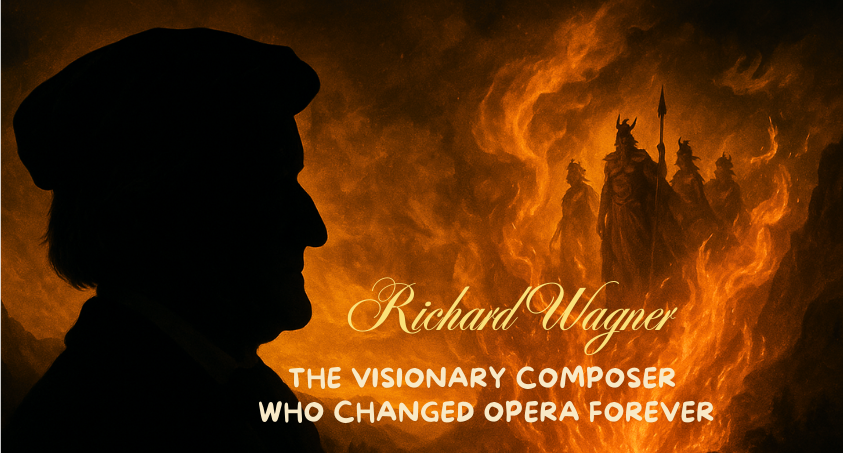
Richard Wagner was more than a composer - he was a force of nature who reshaped the very idea of what opera could be. Born in Leipzig in 1813, Wagner defied convention at every turn, fusing myth, music, poetry, and staging into something unprecedented-a total work of art.
Few composers lived a life as dramatic as the operas they wrote. Richard Wagner (1813-1883) was not only a genius of sound but also a man of contradictions-a revolutionary and a royal favorite, an exile and a festival founder, a despised debtor and a celebrated visionary. His story is as thrilling as the mythic sagas he set to music-a tale of ambition, scandal, and unshakable belief in art's power to reshape the world.
Imagine Dresden in 1849. Amidst gunfire and barricades, a 36-year-old Wagner flees the city after supporting the failed May Uprising.Hunted by police, carrying only manuscripts, he escapes into exile. The same man who dodged soldiers in the street would later build Bayreuth Festspielhaus, a theater visited by kings, philosophers, and music lovers from every corner of the world. This paradox - the outlaw who became an institution-is what makes Wagner endlessly fascinating.
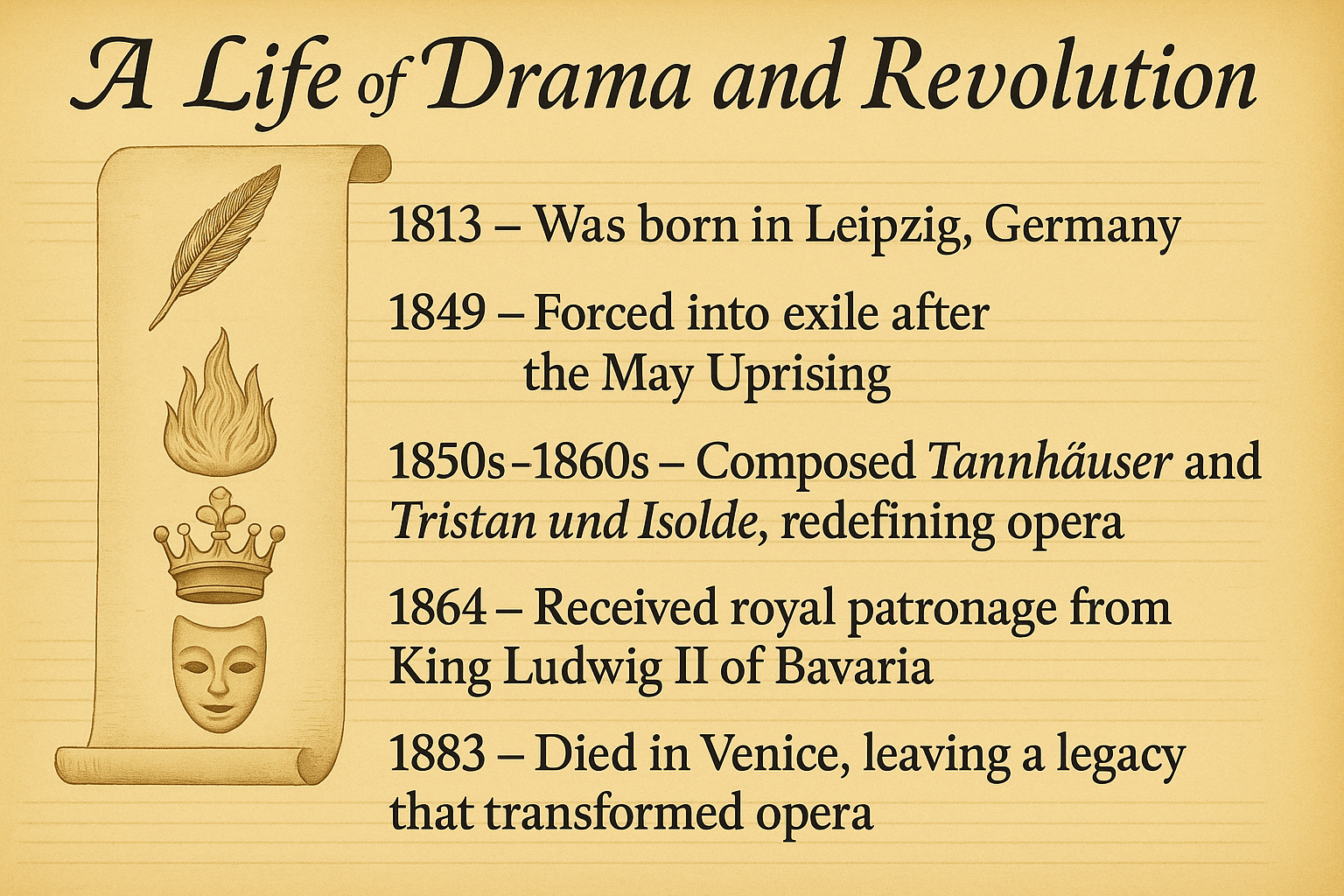
Born in Leipzig in 1813, Wagner grew up in modest circumstances. Unlike Mozart or Mendelssohn, he was not a prodigy with patrons ready to support him. His youth was restless: he obsessed over literature, philosophy, and theatre as much as music. He dreamed of writing not just notes but worlds.
Early works like Rienzi and Das Liebesverbot showed flashes of brilliance but struggled to gain traction. Wagner's arrogance and constant debts earned him enemies as fast as admirers. He once admitted "I have no money, only ideas-but ideas are the currency of immortality."
This tension-outsider ambition against social resistance-defined Wagner's early career. He was a dreamer unwilling to compromise, even when it cost him stability.
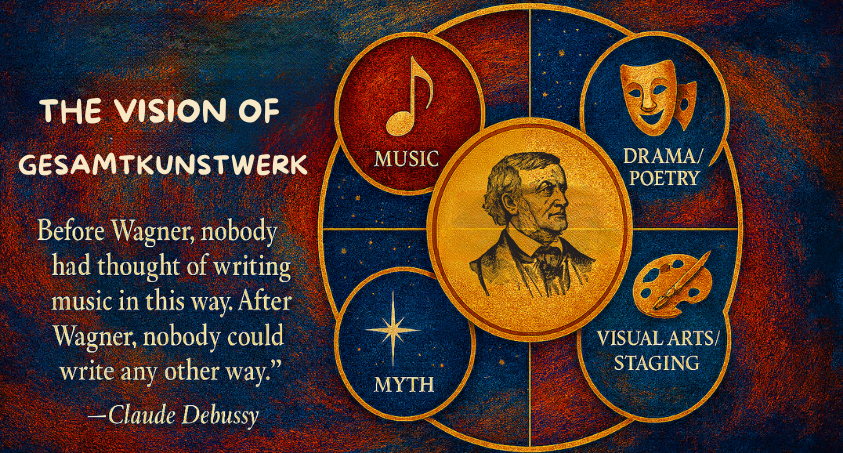
At the heart of Wagner's genius was an idea: Gesamtkunstwerk, or "total work of art." He envisioned opera not as entertainment but as an all-encompassing fusion of music, poetry, staging, and myth.
In his mind, the orchestra would not merely accompany singers; it would speak its own language through leitmotifs - recurring musical phrases tied to characters, objects, and emotions. Scenery, lighting, and drama would merge into a single, immersive experience.
For 19th century audiences accustomed to decorative arias and courtly plots, Wagner's vision was shocking. But he insisted: opera should engulf the listener like myth itself, transporting them beyond the ordinary.
Claude Debussy would later reflect: "Before Wagner, nobody had thought of writing music in this way. After Wagner, nobody could write music any other way."
Wagner's path was rarely smooth. His involvement in revolutionary politics forced him into exile in Switzerland. Financial struggles haunted him - creditors chased him across Europe. His love life was equally tempestuous: his affair with Mathilde Wesendonck inspired the rapturous harmonies of Tristan und Isolde, but also scandalized polite society.
And yet, in the midst of chaos, fortune struck. King Ludwig II of Bavaria, a young monarch infatuated with Wagner's music, became his patron. Ludwig rescued him from crushing debts and gave him the freedom to pursue grand projects. Their relationship - part artistic devotion, part personal fascination - ensured Wagner could complete the colossal Ring Cycle.
This unlikely alliance between a radical exile and a dreamy young king is one of history's thrilling ironies: Wagner, who had fled the police, was now embraced by royalty.
Existing opera houses could not contain Wagner's ambitions. He wanted a space designed for his works alone. Thus, he conceived Bayreuth Festspielhaus, a theater in northern Bavaria, built to his specifications-a hidden orchestra pit, fan-shaped seating, and acoustics that enveloped the listener.
When Der Ring des Nibelungen premiered there in 1876, it was unlike anything audiences had seen. Four operas performed across a week, weaving gods, giants, dwarves, and mortals into a saga of power, betrayal, and redemption.
The world took notice. Artists, aristocrats, and intellectuals traveled to Bayreuth as though on pilgrimage. The idea of the "festival house" dedicated solely to one composer's vision was unprecedented. Today, attending Bayreuth remains one of opera's most sought-after experiences.
Mark Twain, who attended Wagner in Bayreuth, famously quipped: "Wagner's music is better than it sounds." A sly remark, but also an acknowledgment of how overwhelming - almost beyond words - the experience could be.
Wagner's innovations forever altered the course of music. His leitmotif technique became the foundation of modern film scoring. Without Wagner, there might be no Star Wars soundtrack as we know it. His sweeping orchestration influenced Mahler, Strauss, Debussy, and countless others.
Yet Wagner was never just about technique. His works explored primal themes: love defying death (Tristan und Isolde), the struggle for power and its corrupting force (Ring Cycle), the yearning for redemption (Parsifal). These resonate across time, speaking to a universal aspect of the human condition.
Gustav Mahler once said "Wagner is a volcano, an earthquake - and yet he can whisper like a breeze." That paradox captures his genius-overwhelming grandeur balanced by intimate tenderness.
Wagner's life invites both admiration and critique. He was brilliant, uncompromising, often arrogant, and controversial in his personal views. Yet the art he left behind transcends the flaws of the man.
For opera lovers, to engage with Wagner is to wrestle with complexity - both musically and morally. His operas are not easy, but they are unforgettable. Once experienced live, they can alter the way one listens to all music.
As one critic observed - Wagner didn't just compose operas, he built worlds and invited us to live inside them.
From fugitive revolutionary to founder of Bayreuth, Wagner lived a life as theatrical as the sagas he set to music. His story embodies the excitement of a man who refused to back down, who demanded not only to be heard but also to be believed.
Today, whether in Bayreuth, Vienna, Milan, or Berlin, audiences still gather to immerse themselves in Wagner's soundscapes. His works ask much of us - patience, openness, imagination - but they repay us with a depth few art forms can match.
For those ready to journey deeper, experiencing Wagner in Europe is more than a concert-it is walking in the footsteps of a visionary who forever changed opera.
Richard Wagner (1813-1883) was a German composer who revolutionized opera with his concept of Gesamtkunstwerk (total work of art), his use of leitmotifs, and monumental works like The Ring Cycle.
It's the idea of combining music, poetry, staging, and myth into one unified artistic experience, making opera an immersive world rather than just entertainment.
Bayreuth Festspielhaus, built to Wagner's design, is dedicated solely to his works. Its unique acoustics and tradition make it one of the most iconic venues in the opera world.
His use of leitmotifs shaped modern film scoring. Composers from Mahler to Debussy and film composers like John Williams owe much to Wagner's innovations.
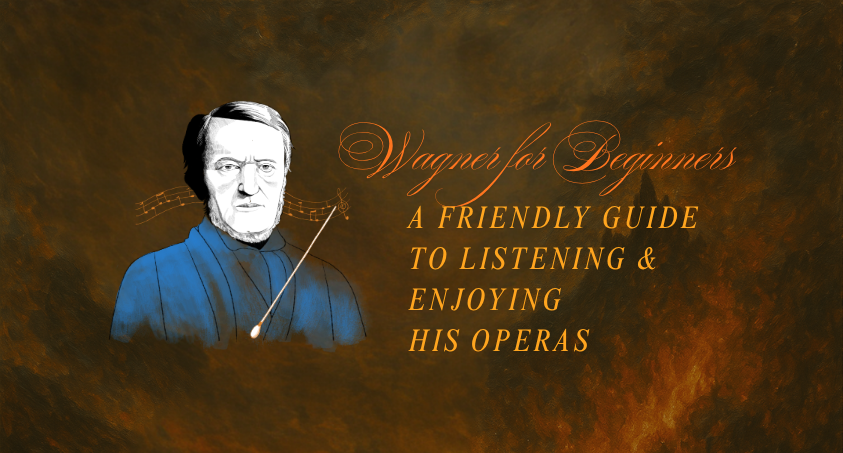
For many first-time listeners, the name Richard Wagner may initially evoke awe, curiosity, and perhaps a hint of hesitation. His operas are famously long, his stories mythic and layered, and his reputation as a revolutionary artist larger than life. The i
September 22, 2025
Richard Wagner was more than a composer - he was a force of nature who reshaped the very idea of what opera could be. Born in Leipzig in 1813, Wagner defied convention at every turn, fusing myth, music, poetry, and staging into something unprecedented.
September 19, 2025
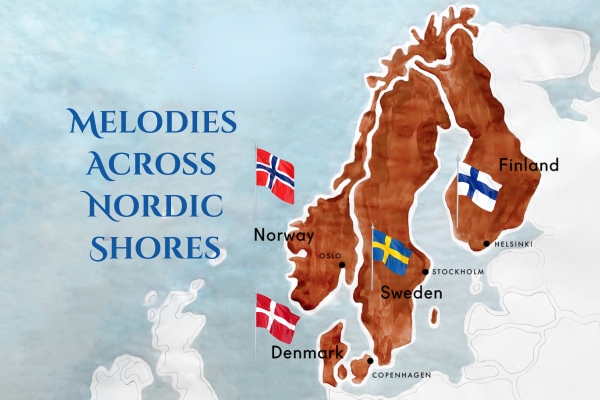
A Cultural Journey Through Time Opera has been esteemed as a significant art form in Scandinavia for many years. It is characterized by the intricate integration of classical traditions with innovative contemporary performances.
December 27, 2024
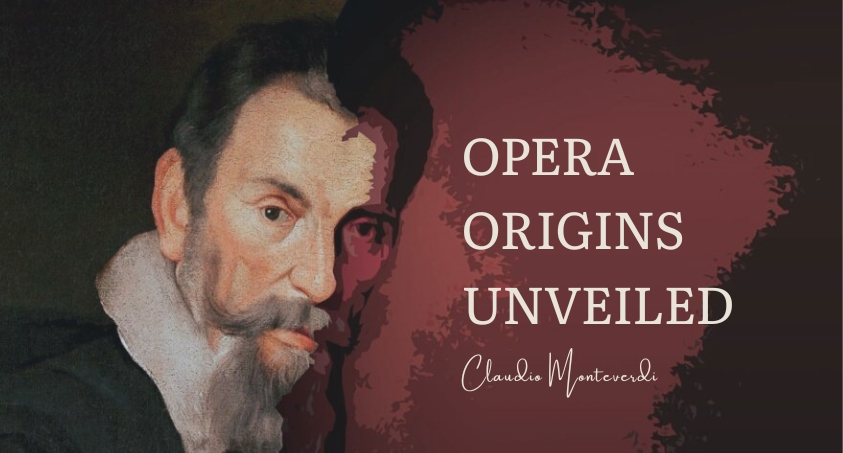
The Renaissance was a period of profound transformation that ushered in a new era of creativity and expression. Among its many artistic innovations, opera stands out as a unique fusion of music, drama, and visual spectacle.
September 05, 2024
Opera, a dramatic art form combining music, singing, acting, and often dance, has captivated audiences for centuries. This guide aims to simplify opera's essential terms and concepts, making it accessible and engaging for beginners.
August 12, 2024